By Irfan Chowdhury
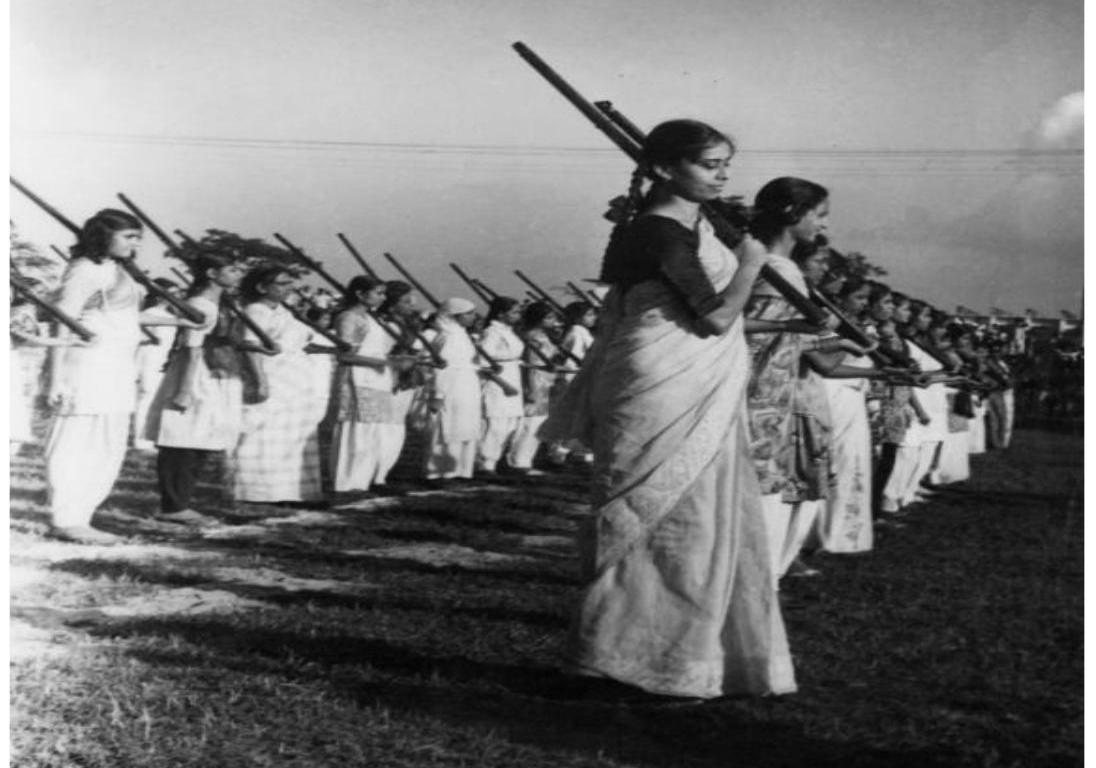
When we look at conflicts, the patriarchy does not focus on the active roles women play, often seeing them as victims or bystanders. While western accounts sometimes feature women in support roles, noticeably, during the wars, they are seldom shown as front line fighters. This is also true for the history of the turbulent period in Bengal between the late 1960s and early 1970s. This era saw two major conflicts in both Bengals: the Naxalite uprising in West Bengal (a peasant class war) and the Bangladesh Liberation War in East Pakistan (a national freedom struggle).
Louise Harrington’s paper, “Women and Resistance in West Bengal and Bangladesh: 1967–1971,” from 2013 argues that women were not just victims but active, militant agents during these upheavals. The paper challenges the traditional history, which is often told only by men, by showing that women were involved in everything from planning and logistics to torture and murder. Harrington makes the point that revolutionary violence is gender-neutral in its execution, even if the consequences for women are severely gendered.
Class and national wars
To appreciate the research scope, one must first recognise the extraordinary political divergence Harrington attempts to bridge. The Naxalite movement, originating in the late 1960s, was primarily a Maoist agrarian rebellion: a desperate, even romanticised, attempt to accelerate a class-based revolution against the entrenched landowning and political elite of the Indian state. Its women combatants were driven by an ideological fervour, seeking to smash the oppressive structures of feudalism and caste alongside patriarchy.
The Bangladesh liberation war of 1971, conversely, was a struggle for freedom — an ethnolinguistic and political secession from the distant state of West Pakistan. Female participants in this were mobilised primarily for the cause of nationhood, serving as nurses, intelligence agents, and in direct combat with the Pakistani military.
Using two short stories, translated from Bengali: Radha Chakravarty’s translation of Selina Hossain’s “Double War” (2007) and Gayatri Chakravorty Spivak’s translation of “Draupadi” by Mahasveta Devi (1981), Harrington links these two movements as expressions of the era’s revolutionary spirit, both willing to use violence for a radically changed future. A key argument is that the social rules that stop women from taking public, aggressive action often collapse fastest during times of existential crisis, like a class war or a war of independence.
However, Harrington notes a tension in comparing them, as their core ideologies were different. The question remains whether the Marxist promise of Naxalism, which aimed to liberate all oppressed groups, offered a more lasting change to gender roles than the nationalism of the Mukti Bahini (the Bangladeshi freedom fighters). Harrington focuses less on the initial promise and more on the end result in cultural memory.
Agency, transgression and retribution
Harrington’s central finding is the concept of transgressive action. These women were truly militants; they did not just offer support—they crossed the line of acceptable female behaviour by perpetrating political violence. By taking up the gun, they briefly claimed a powerful, public space that was historically reserved for men.
The paper argues that the resulting cultural stories and histories cannot tolerate this female over-reach of agency. The penalty for this transgression is a narrative guillotine, where their agency is violently erased and punished.
For example, like in struggles before it, women were involved in the 1971 war in many ways such as providing food and shelter to male muktijoddha (freedom fighters), tending to their wounds and hiding weapons – all vital contributions. Yet, women also took up arms which are almost non-existent in the official narrative:
…the terms muktijoddha and muktibahini referring to male soldiers and the term birangona referring to a raped woman as “war-heroine” have dominated scholarly discussions about 1971, and it is only recently that women’s engagement in combat roles has been acknowledged…” (p.56)
To support this finding, Harrington draws evidence from: recent books (e.g. Women, War, and the Making of Bangladesh: Remembering 1971, by Yasmin Saikia (2011), A Golden Age by Tahmima Anam (2007)); newspaper articles “Fearless Women Fighters” by Manisha Gangopadhyay (The Daily Star, Dec 2004) to show women’s involvement in direct combats including training and forming female guerrilla units; and documentaries and films (e.g. a docu-film: Tahader Juddho (2001) (“Their War”) by journalist Afsan Chowdhury providing interviews with female freedom fighters that uncover their forgotten stories; a film Meherjaan (2011) where the female freedom fighter and the protagonist fulfil her wish to take up arms and seek revenge against her rapists.
A powerful example is also in the analysis of Mahasveta Devi’s short story “Draupadi.” The protagonist, a Naxalite militant, is arrested and gang-raped by state forces. Crucially, the rape is not a random act but the state’s retribution for her militancy. Her political action is reduced to a sexual transgression that demands a violent “correction.” The author argues that this literary device forces the heroic woman back into a purely “bodily space of signification”—her body becomes a political canvas.
This idea is extended to the 1971 war where sexual violence was used extensively against Bangladeshi women by the Pakistani military:
…the plight of Bengali women at this time darkened further when we take into account that it was not only the West Pakistani soldiers who raped them, but also the Bengali men who took advantage of the chaos and carnage of the period to express frustration and anger against their own women by sexually violating them…
…despite the effort to reconcile and romanticise their disturbing experiences in the post-war years, however, the continued physical presence of the raped women, as well as of the West Pakistani-fathered children that many bore, within the new nation served as a reminder of the atrocities of the war…(p. 63)
Whether it is an enemy state using rape to dishonour a nation (1971) or a state narrative punishing female ideological deviance (Naxalites), the woman’s body is used as the ultimate “signifier” for political statements. The ultimate point is that the political subjection of women is overwhelmingly expressed through their sexual subjection.
Limits of literary evidence
While Harrington uses fiction (short stories) to draw conclusions about history, a common approach in post-colonial studies, it requires careful thought. Are these powerful, well-known stories a reliable measure of the experience of all militant women? Or do they mostly represent how the educated, literary elite—often from a privileged background—tried to make sense of the revolutionary chaos?
This elite group might have found the image of a violent, transgressive woman more threatening or more narratively useful than the average participant. The resulting fiction, therefore, might reflect the middle-class’s anxieties about female public power rather than the full reality of the militant women’s lives. A complete historical account would need to dig into state records and oral histories before relying solely on the “fictional shadow.”
Despite this, Harrington’s work is important as it identifies the “grey zone” where historical fact meets cultural denial. The very fact that stories about female revolutionaries often end with a scene of bodily violence suggests a deep discomfort with unpunished female political power. The revolution, it seems, was not strong enough to dismantle the patriarchy; it merely postponed the reckoning.
War for honour
The paper’s powerful critique is directed at the revolutionary project itself. If women join radical movements for liberation from social and gender oppression, the movements’ failure to protect them from retributive gendered violence—even in their own historical accounts—exposes a profound hypocrisy.
In Bangladesh, the national narrative that designated the violated women as Birangona (war heroines) was also a containment strategy. While it seemed to honour them, the label often led to social stigmatisation. Harrington suggests that the patriarchal narrative works in two phases: Punishment during the conflict (violence as a tool) and Pigeonholing afterwards (re-defining their status to manage the discomfort of their experience). Ultimately, the militant woman who fought is replaced in memory by the violated woman who suffered.
Harrington’s paper is a necessary reminder of the limits of political revolution in the face of cultural patriarchy. It forces us to look beyond the glorious stories of national birth and class struggle to the darker, quieter politics of memory.
The paper establishes that women were frontline combatants and agents of change in the Bengali upheavals. However, by analysing the literature, films and documentaries – e.g. In the Wake of Naxalbari: A History of the Naxalite Movement in India (Sumanta Banerjee,1980); Women Freedom Fighter: Better Late Than Never (Naseem Firdaus, 2012); Otiter Jed or Times of Revolution: Ila Mitra, the Santals and Tebhaga Movement (Economic and Political Weekly August 14, 2010); The Everyday Life of the Revolution;Gender, Violence and Memory (Srila Roy, South Asia Research 2007; 1971 and After: Selected Stories (Niaz Zaman 2001); Shadhinota (“A Certain Freedom”) 2003. Film. dir. Yasmin Kabir; Tareque Masud and Catherine Masud. Narir Kotha (“Women and War”) 2000. Film. – Harrington shows that their agency was deemed so transgressive it demanded a harsh, collective narrative punishment.
The grim takeaway is that for women, the revolution offers only a temporary escape from the shackles of convention, and the return journey is marked by an encounter with the same unyielding patriarchal structures.
The paper quietly suggests that the unfinished business of the Bengali liberation struggle is less about political ideology and more about the long, painful work of liberating the female historical subject from her assigned role as a mere bodily signified. The violence of 1971 may have ended, but the narrative war for women’s revolutionary honour continues.
Read the full paper here:

Irfan Chowdhury is an opinion writer.
Works Cited
Anam, Tahmima. A Golden Age. London: John Murray, 2007. Print.
Banerjee, Sumanta. In the Wake of Naxalbari: A History of the Naxalite Movement in India.
Calcutta: Subarnarekha, 1980. Print.
Chowdhury, Afsan, dir. Tahader Juddho [Their War]. 2001. Film.
Firdaus, Naseem. “Women Freedom Fighter: Better Late Than Never…” Bangladesh First. 12
September 12, 2010, Web. April 25, 2012.
Gangopadhyay, Manisha. “Fearless Women Fighters.” The Daily Star, December 16, 2004, Web.
April 25, 2012.
Harrington, Louise, “Women and Resistance in West Bengal and Bangladesh: 1967–1971”,
Journal of Postcolonial Cultures and Societies, ISSN No 1948-1853, 2013.
Hossain, Selina. “Double War.” In Radha Chakravarty, ed. and trans. Bodymaps: Stories by
South Asian Women. New Delhi: Zubaan, 2007: 114-121. Print.
Kabir, Yasmin, dir. Shadhinota (“A Certain Freedom”). 2003. Film.
Masud, Tareque and Catherine Masud. Narir Kotha (“Women and War”). Ain-O-Shalish-Kendra
(ASK) and Audiovision, 2000. Film.
Panjabi, Kavita. “Otiter Jed or Times of Revolution: Ila Mitra, the Santals and Tebhaga
Movement.” Economic and Political Weekly XLV.33, August 14, 2010): 53-59. Print.
Roy, Srila. “The Everyday Life of the Revolution: Gender, Violence and Memory.” South Asia
Research vol. 27, no. 2, (2007): 187-204. Print.
Saikia, Yasmin. Women, War, and the Making of Bangladesh: Remembering 1971. Durham: Duke
University Press, 2011. Print.
Spivak, Gayatri Chakravorty. “Draupadi” by Mahasveta Devi. Critical Inquiry vol. 8, no. 2, (1981): 381-402. Print.
Zaman, Niaz. 1971 and After: Selected Stories. Dhaka: The University Press, Ltd., 2001. Print.
 আলাল ও দুলাল | ALAL O DULAL
The Bangladesh liberation war of 1971, conversely, was a struggle for freedom — an ethnolinguistic and political secession from the distant state of West Pakistan.
???