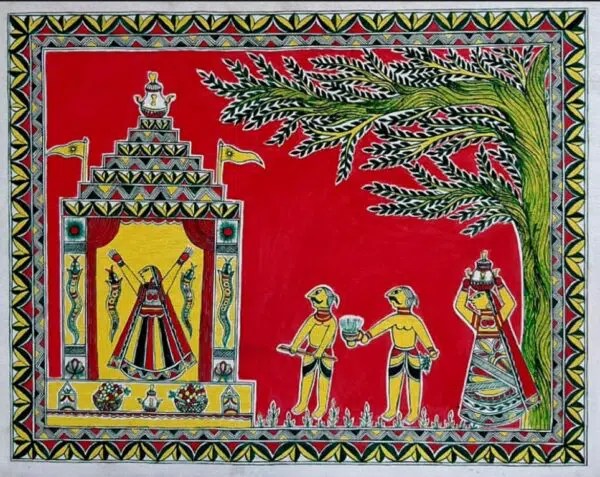
by Anupama Mallick Pal and Ankush Pal
The scholarly gaze, much like capital investment, is selectively applied. For centuries, it has lavished attention on high-profile, high-expenditure Durga Pujas of Bengal’s landed elite, the zamindars. Meanwhile, the vast pantheon of deities venerated by Bengal’s outcasts and Adivasi (indigenous) communities remains underappreciated, even disdained in the mainstream discourse.
This selective visibility is less an oversight than a symptom of epistemic violence, where the responsibility of ‘defining’ falls upon a select few communities, while most have categorisations imposed upon them and are only ‘allowed’ to engage with them after they have been established, if at all.
One cannot discount the colonial governance and not overlook the changes that underwent in Bengal during those times, without which it might be difficult to reconstruct or fathom the processes that led to Durga being a major marker of ‘Bengali’ identity that was then imposed upon communities that each held a different deity as holy. As Talal Asad, a British cultural anthropologist, suggested: without understanding the history of Europe, one cannot explain the ‘local,’ since it is the European ‘past’ that has served as a conduit for universal history (Asad 2009).
The Battle of Plassey of 1757 was followed by relocation of the British East India Company’s capital to Calcutta which was perceived as an opportunity to develop cordial relations with the colonials masters by the Bengali elites. Thus, Durga Puja acted as a space not just for religious expression of the predominantly upper-caste Hindu landed households, but it also culminated with their economic, political, and social ambitions.
A significant amount of academic literature is available on the history of goddess worship, particularly in the fifteenth and the sixteenth centuries (McDaniel 2004; Pintchman 2010; Prajnananda 1990; Rodrigues 2010; Kinsley 2005; Bhattacharji 1998; Banerjee 2004) that coincides with the consolidation of the Mughal empire over this region. Yet, not much has been written that explores the connections between the two, except for a timely intervention (Chatterjee 2013) that attempts to study the engagement of the two, arguing that the ‘first’ Durga Puja–that is credited to three possible candidates–was closely allied with the Mughal regime.
While upper-class Durga Pujas have captured extensive scholarly, literary, and cinematic attention, the rich pantheon of deities venerated by “outcastes” and Adivasis remains largely unexplored in mainstream discourse. This selective visibility reflects deeper structures of epistemic violence, which Braj Ranjan Mani in Debrahmanising History (2005) identifies as the systematic ‘defining’ of marginalised communities by dominant groups. Mani quotes Thomas Szasz, a Hungarian-American psychiatrist, in the preface of the book: “In the animal kingdom, the rule is, eat or be eaten; in the human kingdom, define or be defined.”
The geography of oppression: brutality to bureaucracy
Contemporary discourse on caste violence reveals a troubling geographic bias. Northern Indian states, Rajasthan, Haryana, Uttar Pradesh, dominate headlines with instances of anti-Dalit violence: murders, sexual assaults, public humiliations. This visibility, however, obscures more insidious forms of oppression in supposedly ‘progressive’ states like West Bengal, Tamil Nadu, and Kerala. These ostensibly ‘progressive’ eastern and southern regions have perfected what might be termed “institutional apartheid”—a system where upper-caste dominance operates through bureaucratic capture, educational gatekeeping, and cultural hegemony rather than overt brutality. The absence of dramatic violence creates a veneer of harmony that masks systematic exclusion. As Mani starts in the preface of his book:
Ostentatious use of exquisitely lovely words, and lovelier ideals, such as harmony and peace is neither new nor confined to any particular society. Dominant classes the world over invoke harmony without snapping their ties with the oppressive structures of class, caste, and gender hierarchies.
Here, upper-caste dominance operates not through overt brutality, which is subject to transaction costs and legal risk, but through the bureaucratic capture of state institutions, educational gatekeeping, and a pervasive cultural hegemony. Absence of dramatic violence creates a veneer of harmony, masking a systematic, perhaps low-intensity exclusion.
Religious practice becomes a particularly powerful site of this subtle violence. When certain deities are relegated to ‘folk tradition’ while others achieve ‘classical’ status, when particular worship practices are deemed ‘superstition’ while others represent ‘authentic spirituality,’ we witness the operation of what French Sociologist, Pierre Bourdieu might call symbolic violence, the imposition of meaning that conceals power relations.
Manasa showcases politics of recognition
The marginalisation of the serpent goddess Manasa exemplifies this process. Despite archaeological evidence of serpent worship dating to the Indus Valley Civilisation, and continuous practice across millennia, such traditions are consistently positioned as derivative, primitive, or heterodox within dominant Hindu discourse. The worship of Manasa offers a compelling case study in how marginalised religious traditions mirror and model social resistance.
Historically confined to communities like the Namashudras (formerly Chandals), this practice reveals striking parallels between divine and human struggles for recognition. In the Manasa Mangal Kavyas, particularly Bijoy Gupta’s version, the goddess’s conflict with Chand Saudagar represents more than mythological drama; it encodes a template for challenging patriarchal and caste authority. When Chand repeatedly dismisses Manasa as ‘Laghujaati Kani‘ (the one-eyed woman of low caste), he articulates the precise logic of exclusion that upper-caste society deployed against Dalit communities.
Both goddess and community employed remarkably similar strategies in their bids for recognition. Manasa’s eventual triumph, compelling Chand’s worship, even if only with his left hand, mirrors the Namashudras’ political approach: persistent negotiation rather than revolutionary confrontation. The community’s strategic choices, demanding name changes from the pejorative ‘Chandal,’ organising through Namashudra conferences, tactically abstaining from the Swadeshi movement, appealing to colonial authorities via the Simon Commission, demonstrate sophisticated political consciousness.
This parallel suggests that marginalised religious traditions function as more than spiritual practice, they serve as repositories of political memory and laboratories for resistance strategy. The goddess’s mythological triumph provides a cultural blueprint for communities seeking recognition within hostile social structures.
Vernacular historiography – spectral sacred spaces
Our family’s annual observance of Manasa Puja illustrates how individual households become carriers of broader historical processes. This tradition, traceable at least five generations to our ancestors in Singur before migration to Shyamnagar, represents what might be called “vernacular historiography,” the preservation of alternative temporalities and epistemologies outside institutional control. The timing itself is significant. While orthodox practice privileges Naga Panchami, our observance suggests retention of older, possibly pre-Brahmanical seasonal frameworks.
As Asutosh Bhattacharyya (1958) documents, regional variations in Manasa worship timing indicate community autonomy in ritual scheduling, a form of temporal resistance to standardised religious calendars imposed from ‘above.’The dream narrative central to our family tradition deserves careful analysis. According to family oral history, when migration threatened abandonment of religious practice, a different goddess–Chandi–appeared in dreams, compelling our ancestors to retrieve and relocate the household deities, including herself, Shitala, and Manasa.
This intervention narrative performs several sophisticated cultural functions. First, it establishes divine authorisation for religious innovation, when institutional religious authority proves inadequate, direct divine communication provides alternative legitimacy. Second, it transforms potential cultural loss into divinely mandated preservation. Third, it creates what anthropologists might recognise as ‘sacred mobility,’ the ability of divine presence to transcend geographic boundaries through human agency.
The continuation of worship in Shyamnagar despite the family’s geographic dispersal creates a fascinating phenomenon: sacred space maintained through collective memory and periodic ritual return rather than continuous physical presence. This challenges dominant conceptions of Hindu sacred geography, typically organised around permanent temples and established tirthas. Instead, our practice suggests alternative cartographies of the sacred based on family lineage, community history, and divine intervention rather than Brahmanical authority or royal patronage. Such ‘spectral sacred spaces’ maintain religious efficacy through memorial practices and seasonal return, offering flexible models of devotional geography suited to mobile communities. The transformation of Manasa worship from exclusively Namashudra practice to broader Bengali acceptance illustrates complex dynamics of cultural co-optation in postcolonial South Asia.
The goddess eventually gained recognition in later Puranas, the Padma, Devi Bhagavata, and Brahma Vaivarta Puranas (Jash 1986), representing institutional accommodation of folk traditions within orthodox frameworks. This process typically follows predictable patterns: marginalised religious practices gain visibility, elements threatening to dominant hierarchies are excised or reinterpreted, and the sanitised tradition receives orthodox legitimation. The radical potential of Manasa worship, its challenge to Brahmanical authority, its roots in non-Aryan communities, its feminine assertion against patriarchal power, becomes domesticated through Puranic integration.
Yet complete co-option remains elusive. Families like mine participate in what Antonio Gramsci might recognise as ‘contradictory consciousness,’ simultaneously accepting and resisting hegemonic cultural forms. By maintaining worship practices rooted in marginalised communities, we preserve spaces for alternative religious imagination that escape total subsumption into orthodox Hinduism.
This persistence across generations and geographic boundaries suggests that reports of tradition’s demise under modernity may be premature. Rather than disappearing, marginalised religious practices demonstrate remarkable adaptive capacity, surviving precisely through flexibility and resistance to institutional control.
Unlike the grand temples and institutionalised worship of dominant Hindu deities, such traditions operate through domestic spaces, oral transmission, and informal networks. This infrastructural difference proves politically significant. While orthodox religious practice requires substantial material resources, institutional support, and elite patronage, folk traditions maintain themselves through household ritual, community memory, and grassroots transmission. Such decentralised preservation makes them remarkably resilient to political suppression while maintaining democratic accessibility.
The persistence of marginalised religious traditions maintains what might be called ‘archives of possibility,’ alternative models of social organisation, divine authority, and community belonging that can be mobilised during moments of political transformation.
A hidden transcript
The post-colonial acceptance of manasa by later puranas represents the institutional accommodation of folk traditions, often following a predictable pattern of sanitisation and integration:the challenge to Brahmanical authority, non-Aryan roots are excised or reinterpreted. This domestication limits the goddess’s radical potential. Yet, families like ours maintain contradictory consciousness, simultaneously accepting and resisting hegemonic cultural forms.
When contemporary Dalit movements invoke figures like Ravana or Mahishasura as heroes rather than demons, they draw upon precisely these alternative religious memories. Similarly, the continued worship of deities like Manasa keeps alive visions of divine recognition for the socially marginalised, feminine authority within patriarchal structures, and spiritual legitimacy outside Brahmanical mediation.
Such practices constitute what Partha Chatterjee calls the ‘spiritual domain’ of cultural resistance, spaces where alternative modernities can be imagined and rehearsed. In an era of intensifying religious nationalism and cultural homogenisation, practices like our family’s Manasa worship become particularly significant as sites of diversity and democratic possibility. They demonstrate how marginalised communities maintain cultural autonomy within dominant systems, preserving alternative epistemologies that resist reduction to sanctioned orthodoxies.
The Manasa Puja represents more than religious observance, it constitutes active participation in cultural preservation, quiet resistance to hegemonising forces, and maintenance of spaces where ‘different ways’ of being Hindu remain possible. Through such domestic rituals, individual families become custodians of historical memory, keeping alive possibilities for more inclusive and democratised forms of spiritual life. This persistence suggests that the struggle for recognition, whether of goddesses or communities, continues to be written into the fabric of everyday practice.
Like Manasa herself, marginalised traditions achieve legitimacy not through institutional sanction but through patient persistence, strategic adaptation, and the quiet revolution of sustained practice across generations. In maintaining such traditions, families like ours participate in the ongoing work of expanding the boundaries of belonging within Indian society, one household ritual at a time. In an era of intensifying religious nationalism, practices like Manasa worship are crucial sites of democratic possibility. They demonstrate how marginalised communities maintain cultural autonomy within dominant systems.
The Manasa Puja is more than religious observance; it is an active engagement in cultural preservation, a quiet resistance to homogenising forces, and a sustained effort to expand the boundaries of belonging within the wider Indian society.
Anupama Mallick Pal is a translator and writer interested in medieval and oral histories of subaltern communities. Ankush Pal is a sociologist trained at the London School of Economics and Political Science, who researches inequalities, public space, South Asian culture, and urbanisation. He is currently working on spatiality, infrastructural imperialism, and poly-coloniality in Bengal.
Works Cited
Asad, Talal. 2009. Genealogies of Religion: Discipline and Reasons of Power in Christianity and Islam. Johns Hopkins University Press.
Banerjee, Sudeshna. 2004. Durga Puja: Yesterday, Today & Tomorrow. Rupa & Co.
Bhattacharji, Sukumari. 1998. Legends of Devi. Disha Books.
Bhattacharya, Ashutosh. 1958. Bangla Mangalkabyer Itihash. Kolkata Book House.
Bhattacharya, Tithi. 2007. ‘Tracking the Goddess: Religion, Community, and Identity in the Durga Puja Ceremonies of Nineteenth-Century Calcutta’. The Journal of Asian Studies 66 (4): 919–62.
Bhattacharyya, Monolina. 2024. ‘Ambition and Competition among Hindu Bengali Elites in Eighteenth- and Nineteenth-Century Calcutta: The Festival of Durga Puja’. Journal of Festive Studies 6 (December): 214–38. https://doi.org/10.33823/jfs.2024.6.1.147.
Chakrabarti, Kunal. 2001. Religious Process: The Purāṇas and the Making of a Regional Tradition. Oxford University Press.
Chatterjee, Kumkum. 2013. ‘Goddess Encounters: Mughals, Monsters and the Goddess in Bengal’. Modern Asian Studies47 (5): 1435–87. https://doi.org/10.1017/S0026749X13000073.
Chattopadhyay, Swati. 2019. ‘Fabricating Community and Public Space in Kolkata’s Durga Puja’. Perspecta 52: 208–20.
Jash, Pranabananda. 1986. ‘The Cult of Manasa in Bengal’. Proceedings of the Indian History Congress 47 (1): 169–77.
Kinsley, David Robert. 2005. Hindu Goddesses: Visions of the Divine Feminine in the Hindu Religious Tradition. Repr. Motilal Banarsidass.
Mani, Braj Ranjan. 2007. Debrahmanising History: Dominance and Resistance in Indian Society. Repr. Manohar.
McDaniel, June. 2004. Offering Flowers, Feeding Skulls: Popular Goddess Worship in West Bengal. Oxford University Press.
Pintchman, Tracy, ed. 2010. The Rise of the Goddess in the Hindu Tradition. State University of New York Press.
Prajnananda, Swami. 1990. Mahisasuramardini Durga. Sri Ramakrishna Vedanta Math.
Ray, Manas. 2017. ‘Goddess in the City: Durga Pujas of Contemporary Kolkata’. Modern Asian Studies 51 (4): 1126–64. https://doi.org/10.1017/S0026749X16000913.
Rodrigues, Hillary, ed. 2010. Ritual Worship of the Great Goddess: The Liturgy of the Durgā Pūjā with Interpretations. McGill Studies in the History of Religions. State University of New York Press.
 আলাল ও দুলাল | ALAL O DULAL
Thanks for sharing this amazing and thought-provoking article. Regards, Adil Khan