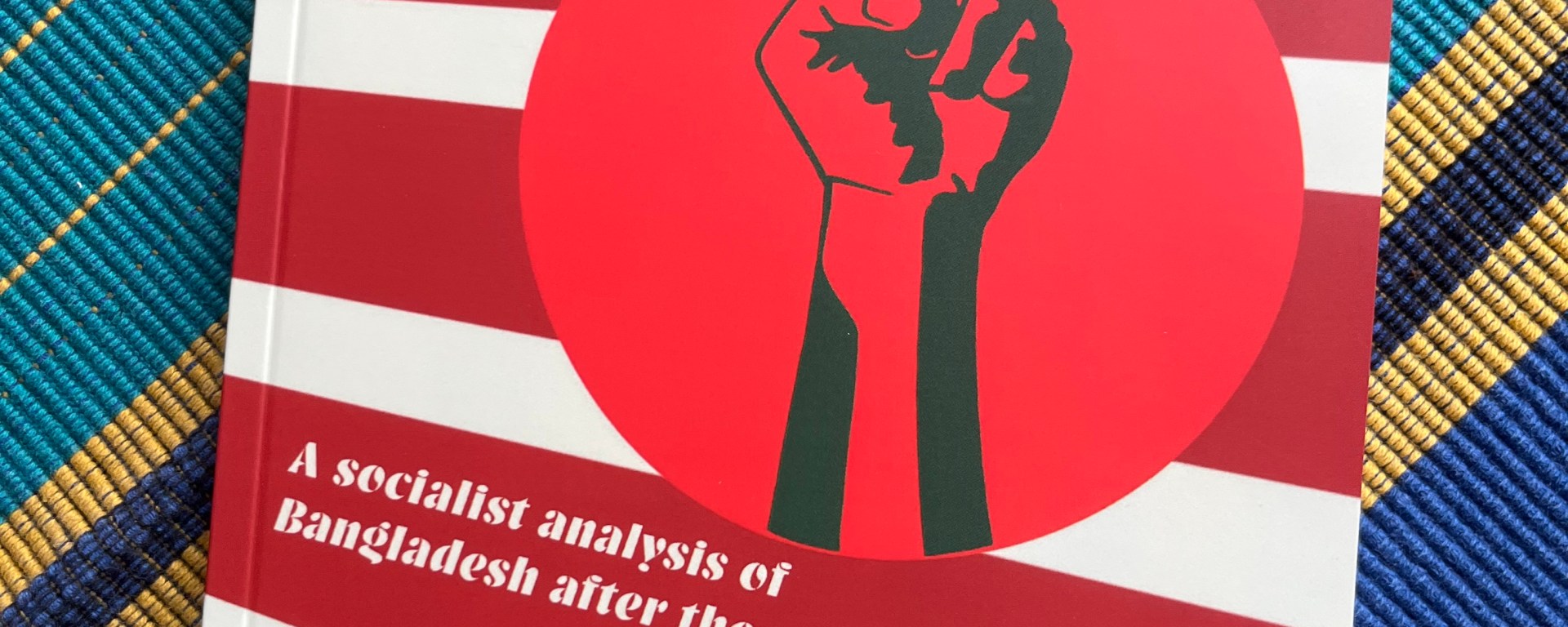
By Naomi Hossain
Did you have high hopes?
Did you have high hopes for the Bangladesh uprising, the Bloody July of 2024? My own hopes were limited: that the unhinged rule of Sheikh Hasina’s Awami League would come to an end. It had to stop. Whatever legitimacy the Awami League had earned with its developmental offer – and that story had worn transparently thin – was squandered in its chaotic orgy of revenge against student protestors and their working-class allies. You only have to look at the visuals to know the protestors came from across the political spectrum, across the country, and from across classes. Everyone wanted to remove the brutal autocrat.
But beyond the removal of the Awami League, in a polity without a viable opposition, with a civil society crushed, coopted and tamed by the party-state and a bankrupt aid system, a state whose institutions had become barely more than the vehicles for robber barony, the aftermath was always going to be messy and uncertain. At best.
Did anyone really believe that a popular democracy, let alone a progressive economic model would emerge from the ashes? Perhaps not, or perhaps there was no time to believe anything. Remember, it was a spontaneous combustion of pent-up forces, not a movement with a plan. There was no blueprint for the day after, no organized force capable of setting one out. The erstwhile opposition, the BNP had not used their 15 years in waiting to build towards better politics, contenting themselves with reminding everyone that it was their turn at the trough. At least some of the myriad Islamists had been organizing, by contrast. We are starting to see the fruits of their grassroots mobilization, most strikingly in the Dhaka University student union elections.
What’s left of the left?
What of the left? The short answer is: there isn’t one. If we didn’t already know this, the exceptionally sharp and intelligent analysis in Inquilab Zindabad? A socialist analysis of Bangladesh after the uprisings makes the point amply, supported (unlike much of the uprising analysis to date) with credible evidence and thoughtful analysis. Authored by Safieh Kabir, Azfar Shafi and Saif Kazi for Nijjor Manush, a ‘socialist organization for Bangladeshis, as well as Bengalis, based in Britain’, Inquilab Zindabad? analyses the events of last year and their aftermath from the perspective of the left. It explores their role in variously propping up and challenging the Awami League regime; how leftist student and other groups helped drive the uprising; their sidelining in the civil society-led interim government; and their absence from the emerging political landscape. It is a sobering account of a revolutionary moment that never was, perhaps never could have been:
Decades of repression, co-optation, and stagnation have left Bangladesh’s traditional socialist parties a shadow of their former selves. The historic decline of this once influential socialist movement has been sorely felt in the aftermath of the uprisings, robbing the movement of greater ideological and organizational potency to steer a transformative course in the year since. (Page 116)
The death of the Bangladeshi left is of course not exclusive to Bangladesh’s troubled political economy. The authors situate its mortality squarely within their analysis of late global capitalism, noting that:
Bangladesh is confronting the pattern seen across many countries, particularly those in the Global South, reaching the final limits of neoliberalism – where the status quo has made the conditions of life impossible to bear, but the destruction of political life has left the masses without a clear political standard-bearer for change. (page 116)
Vehicles for change?
What of the political standard-bearers now on the field? The Awami League is, for now at least, on ice. The BNP appears to be fighting old wars even though their enemies and battlefields are new, banking on the lack of an alternative to de facto themselves into power.
The analysis of the National Citizens Party, the political platform patched together from pieces of the student movement, is penetrating yet not entirely devoid of optimism. The authors see the NCP as ‘militantly centrist’: ‘invoking the aesthetic of revolution with the programme of liberal, democratic capitalism’ (page 98). The NCP nods to national sovereignty (against India and Pakistan), makes strident claims to ridding the nation of the scourge of ‘Mujibism’ (including constitutional commitments to socialism and secularism), and displays a high degree of comfort with the Islamic Right. But does this amount to a political agenda for a viable party? Probably not:
NCP’s emphasis on ‘political inclusivity’ and technocratic middle-ground politics may work for a single-issue campaign, a protest movement or an NGO. However it does not inspire confidence as the sustainable basis for a political party … its anti-ideological politics can shade into indecisiveness and, ultimately, into a lack of political conviction. The problems facing Bangladesh cannot be resolved by another actor entering its already crowded array of centrist parties. (page 104)
The authors do not quite suggest that the NCP could have been a different, and more successful, party had they done the hard work of developing an alternative, progressive economic model. Perhaps that is the subtext. They do note that while the student-led movement was ultimately successful because of its allies in the working classes, workers and their concerns are markedly absent from the NCP’s programme. It seems a remarkable own-goal for a student movement that had showed some astuteness in its organizing across classes. The deadweight of fighting Mujibbad seems to have sucked all other ideologies out of the political air.
Always the economy, stupid
My one reservation about their otherwise penetrating analysis is my standard complaint about leftist analysis of Bangladeshi politics: the failure to recognize that development has not entirely been a ‘halluci-nation’ (as the authors call it). (The hyperbolic White Paper on the economy has not helped in this regard, pushing a narrative that Bangladesh had no development in the Hasina years that is more politically convenient than empirically-founded.) The educated middle classes have a chronic blind spot when it comes to understanding the politics of development in Bangladesh, preferring doctrinal debate and geopolitical conspiracy to analysis of why the existential threat of hunger, poverty and disasters pushed it into the arms of international donors and their neoliberal policies, or indeed why for the majority of Bangladeshis it is indeed better to be exploited by global capitalism than not to be so exploited.
Gen Z have little firsthand experience of the mass deprivation, the starving and displaced millions, that forged a developmental consensus centred on integration and growth in the world economy. And this is among the reasons they routinely fail to understand why Sheikh Hasina lasted as long as she did: the average Bangladeshi was moderately satisfied with Awami League rule because they enjoyed some degree of economic progress up until 2022, when the global cost of living crisis put an end to Hasina’s narrative of development success. The left forgets that even if you’re at the bottom of the global value chain, capitalism has its emancipatory potential, particularly for landless agrarian people mired in debt and disaster, particularly for women in a robust if negotiable patriarchy. You can never understand Bangladeshi politics if you don’t understand the politics of development in Bangladesh. That is neoliberal and exploitative etc etc is just not enough.
The failure to see the wood of economic progress through the trees of Bangladesh’s crony capitalism is but a minor gripe, and while it affects the analysis as a whole, it is not fatal: the account of the politics is sound, balanced, evidenced, and grippingly told. Read this short book; someone please translate it into Bangla. I devoured it the weekend it arrived. It is a stirring yet reasoned analysis of why the revolution was stillborn (yet again), and I could barely put it down. I just hope the authors are correct when they detect the
new shoots of a Left revival … the scattered forces – some rooted in Marxist study circles, others in community struggles [that] hint at the potential for a reinvigorated Left built from the ground-up.
Naomi Hossain is the author of ‘The Aid Lab: Understanding Bangladesh’s Unexpected Success‘ (2017).
 আলাল ও দুলাল | ALAL O DULAL
Hello, Greetings from Dhaka. I would like to translate the book in Bangla. Can I have the permission, please! Best, Rezwan